What’s Inside a Vape Kit? Understanding the Technology Behind Different Devices
 By Vaping Dubai•31 October 2026•18 min read
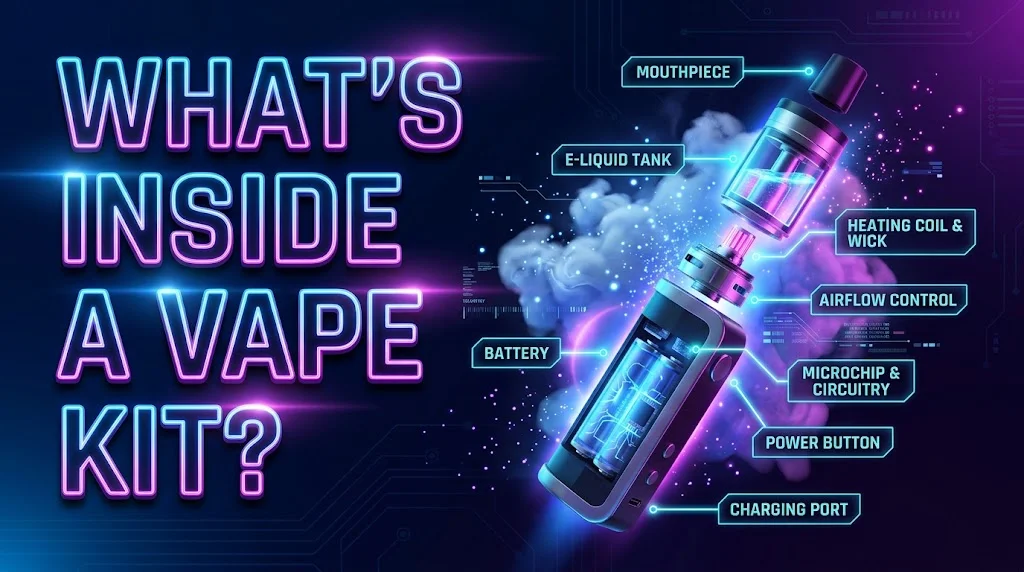
Have you ever looked at a vape kit and wondered how so many things fit inside such a small device? From the outside, it might look like a simple electronic product with a mouthpiece, a button, and a small screen. But inside, several components work together to manage electrical power, detect airflow, heat an element, and control the movement of liquid.
That is what makes the technology interesting. A vape device is not built around one single component. It combines electrical circuits, heating elements, liquid storage, sensors, and airflow channels in a compact structure. Understanding how these parts connect gives us a clearer picture of the engineering behind modern vape technology in Dubai and elsewhere.
A Look Beneath the Outer Shell of a Vape Kit
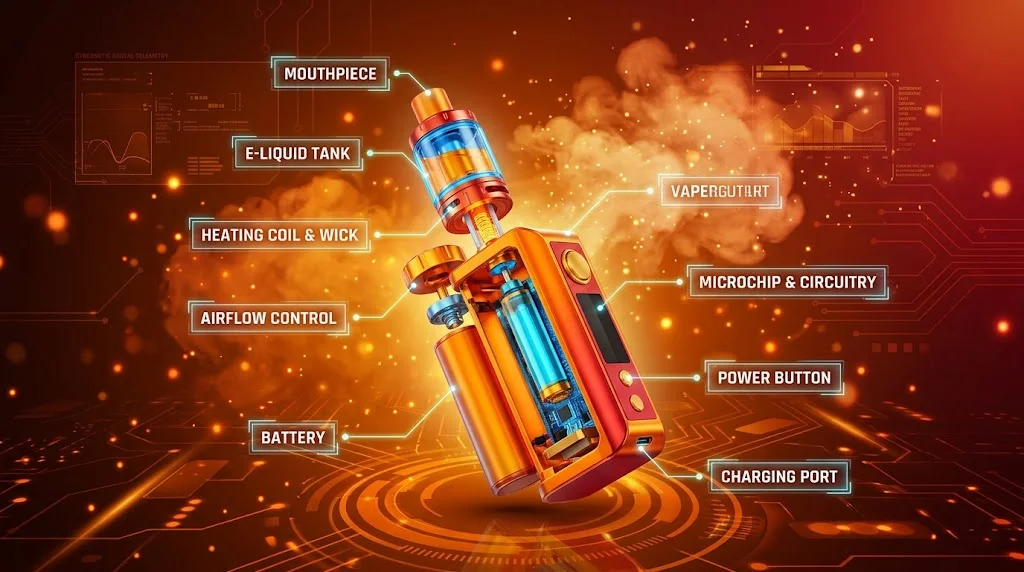
The easiest way to understand a vape kit is to look at it as a collection of connected systems. Each part has a particular role, but none of the main systems works entirely on its own. The battery supplies electrical energy, the control circuit manages certain functions, and the heating assembly contains the element that produces an aerosol from the liquid.
The arrangement can look quite different depending on the device. Some have a compact body with most components fitted into a single housing. Others separate the battery section from the tank or pod. Despite those differences, many devices share a similar basic architecture: an electrical power source, a heating assembly, a liquid container, and an airflow path.
The Electronic System That Powers a Vape Device
The electronic system is the foundation of a battery-operated vape device. It provides the electrical energy needed by the heating assembly and, depending on the model, manages activation, power output, charging, and display functions.
When looking at vape device components in Dubai, it helps to understand that the electronic system is not necessarily the same in every model. A simple device may use a relatively basic circuit, while a more advanced design can include additional control components and electronic features.
The Battery and Electrical Power Supply
The battery provides the electrical energy required by the device. Many rechargeable models use lithium-ion battery technology because it can store energy in a relatively compact space. The battery is usually positioned inside the main body, although some larger devices have a removable battery arrangement.
Battery capacity is commonly expressed in milliampere-hours (mAh). This figure describes the battery’s electrical charge capacity, but it does not independently explain how long a device will operate. Actual power use also depends on the device’s electrical design, heating element, and control settings.
The battery connects to the internal circuit through electrical contacts and conductive pathways. These connections allow energy to reach the components that need it. In a compact design, the battery and circuit board may sit close together to reduce the amount of space required inside the housing.
The Chipset and Control Circuit
The chipset or control circuit acts as the electronic management centre of devices that include one. It receives information from activation sensors or buttons and controls how electrical power is delivered to the heating assembly.
Depending on the model, the circuit may also manage charging, monitor battery conditions, control a display, and respond to certain electrical faults. More advanced devices can include additional electronic controls, while simpler models may use a much less complex circuit.
It is useful to distinguish between the chipset and the battery. The battery supplies energy, while the control circuit manages how that energy is used. They perform different jobs, even though they work together as part of the same electronic system.
Electrical Connections and Internal Wiring
The battery, circuit board, sensors, and heating assembly need electrical connections to communicate or transfer power. These connections may use wires, metal contacts, soldered joints, or conductive tracks on a printed circuit board.
A printed circuit board (PCB) provides a structured surface for mounting and connecting electronic components. Instead of placing separate wires between every small component, a PCB can use carefully arranged conductive paths to connect them.
The quality and arrangement of these connections matter to the overall design. A loose contact or damaged connection can interrupt the electrical path, while a properly designed circuit helps the different electronic components work as intended.
The Engineering Behind the Heating Assembly
The heating assembly is another central part of the device. It contains the heating element and, in many designs, a wick that brings liquid into contact with the heated area. These components are positioned so that electrical energy can be converted into heat within a small space.
The basic idea is straightforward, but the physical arrangement requires careful engineering. The heating element, wick, liquid chamber, and airflow path must fit together inside the available space.
Understanding the Heating Element
The heating element, commonly called a coil, is a conductive component that produces heat when electrical current passes through it. It is usually made from a type of resistance wire or another suitable conductive material.
When the device is activated, electrical energy reaches the heating element and causes its temperature to rise. Liquid present around the wick and heating area is then heated, producing an aerosol. This process is different from burning tobacco because the device uses electrical heating rather than combustion.
The heating element’s electrical properties influence how it responds to the supplied power. Its resistance, material, shape, and position are all part of the overall engineering design.
Coil Construction and Materials
A coil is not simply a piece of wire placed inside a device. Its construction can involve a particular wire material, shape, diameter, and arrangement. Different designs use different coil configurations depending on the device’s structure and intended electrical characteristics.
Common coil materials include Kanthal, stainless steel, and nichrome. Some devices use other materials or specialised heating structures. The exact material and construction depend on the manufacturer and model.
The coil is also positioned in relation to the wick and airflow channel. This arrangement allows the heating element to receive electrical power while remaining connected to the liquid delivery system. The design must account for both electrical and physical requirements within a limited space.
The Wick and Its Internal Structure
The wick is the material that carries e-liquid towards the heating element. Cotton is commonly used, although other materials and structures can also be found in different designs.
Its internal structure contains small spaces that allow liquid to move through the material by capillary action. This is the same general physical principle that allows liquid to travel through a narrow porous material without a pump.
The wick sits close to the coil so that liquid can reach the heated area. Its position and contact with the liquid reservoir are important parts of the heating assembly. In some devices, the wick and coil are included in one replaceable unit, while other designs arrange them as separate components.
How E-Liquid Moves Through the Device
The liquid storage and delivery system is closely connected to the heating assembly. A device needs a chamber to hold its liquid and a physical route through which the liquid can reach the wick.
The design of that route depends on the type of device. Some use a removable pod, while others use a separate tank. In either case, the container and liquid channels are arranged around the heating assembly.
The Role of the Pod or Tank
A pod or tank provides the space where e-liquid is stored. A pod is generally a compact container designed to fit into a matching device body. A tank is commonly a separate liquid reservoir connected to a larger device.
Some pods are prefilled, while others are designed to be refillable. Tank-based arrangements usually have a separate reservoir that holds liquid around or above the heating assembly, depending on the design.
The container also needs to connect with the rest of the device. This may involve physical fittings, electrical contacts, and openings that allow liquid and air to move through the appropriate internal channels.
Liquid Channels and Wick Connection
Liquid channels connect the storage area with the wick. Their purpose is to allow e-liquid to reach the material surrounding the heating element.
The wick draws liquid through its porous structure by capillary action. This means the device does not necessarily need a mechanical pump to move liquid towards the heating area. The physical properties of the wick and the arrangement of the liquid openings help support the movement.
The exact structure varies between models. Some designs use small openings in a pod or coil housing, while others have more visible liquid channels around the heating assembly. These differences are part of the internal layout rather than a universal feature shared by every device.
Understanding Integrated and Replaceable Components
The heating assembly can be arranged in more than one way. Some devices combine the coil and wick into a single integrated component, while others allow the coil unit to be separated from the tank or pod.
The main structural differences include:
- Integrated coil: The heating element and wick are built into the pod or cartridge as one unit.
- Replaceable coil: The coil assembly is designed to be removed from its housing and replaced separately.
- Separate tank arrangement: The liquid reservoir and heating assembly are distinct parts connected within the device structure.
These arrangements affect how the internal components are organised. They also explain why two devices with similar outer shapes can have quite different internal layouts.
The Engineering Behind Airflow Design
Airflow is another important part of the internal structure. A device needs a route for air to enter, pass through the relevant internal area, and reach the mouthpiece. The position and shape of this route depend on the device’s design.
Although airflow channels may look simple from the outside, they have to fit around other components. The battery, liquid reservoir, heating assembly, and outer housing all influence how much space is available for air to move.
Air Inlets and Internal Air Channels
Air inlets are openings that allow outside air to enter the device. From there, internal channels guide the airflow towards the heating assembly and mouthpiece.
These channels can be formed inside the device housing, pod, tank, or coil structure. Some designs use a relatively direct route, while others have a more complex path because of the position of the internal components.
The mouthpiece forms the final part of the airflow route. It connects the internal channel with the outside of the device, completing the physical passage through which the aerosol travels.
How Airflow Design Varies Between Devices
Not every device uses the same airflow arrangement. Compact pod systems often have a more integrated structure, with the air inlet and internal channel built into the pod or device body. Larger devices may use a separate tank with its own airflow openings and adjustment mechanism.
Some designs include adjustable airflow controls, while others use fixed openings. The choice depends on the device’s architecture and the way its components are arranged.
This is one reason the internal construction of vape kits in Dubai can vary significantly even when two products appear similar in size. Their airflow channels, heating assemblies, and liquid reservoirs may be organised in different ways.
The Small Electronic Features You May Not Notice
Some components are easy to overlook because they are small or hidden beneath the outer casing. However, they still play a role in how a device operates. Sensors, buttons, indicators, and protective circuits can all form part of the electronic layout.
Not every device includes the same features. The number and complexity of electronic components depend on the model and its design.
Activation Buttons and Draw Sensors
A button-activated device uses a physical button to send an activation signal to its control circuit. When the button is pressed, the circuit can respond by allowing electrical power to reach the heating assembly.
Other devices use airflow or pressure sensors. These sensors detect a change in air pressure when air is drawn through the device. The electronic circuit then interprets that signal as an activation request.
Some models combine a button with sensor-based activation, while others use only one method. The CDC’s E-Cigarette, or Vaping, Products Visual Dictionary provides labelled illustrations of common components, including the battery, atomizer, sensors, and cartridge.
Screens, Indicators and Display Circuits
Some devices include a small screen or LED indicators. These components provide visual information about certain device functions, depending on the model.
A screen may be connected to the control circuit and display information such as battery status, selected settings, or other device data. Simpler designs may use a small light to indicate activation or charging status instead of a digital display.
The display itself is only one part of the system. It needs an electronic connection to the control circuit, which processes the relevant information and sends the appropriate signal to the screen or indicator.
Built-In Electronic Protection Systems
Some electronic devices include protective functions designed to respond to particular electrical conditions. Depending on the model, these may include:
- Short-circuit protection: Designed to detect certain abnormal electrical connections.
- Overcharge protection: Helps manage charging conditions when the battery reaches a defined limit.
- Overheat protection: May respond when the device detects an excessive temperature.
- Low-voltage protection: Can restrict operation when the battery voltage falls below a specified level.
These features are not universal, and their presence or operation depends on the device’s electronic design. A protection feature should not be interpreted as a guarantee that a device cannot malfunction or become unsafe.
Why Different Vape Kits Have Different Internal Structures
The main components may sound familiar across different devices, but their arrangement can change considerably. A compact pod system has different space requirements from a larger box-style device. That affects where the battery, circuit board, liquid reservoir, coil, and airflow channels can be positioned.
Looking at these differences helps explain why there is no single internal layout for every device.
The Internal Layout of Pod Systems
Pod systems generally use a compact design in which the battery and electronic components sit inside a small main body. The pod fits into this body and contains the liquid reservoir and, depending on the model, the heating assembly.
Some pods have integrated coils, while others use replaceable coil units. Electrical contacts connect the pod’s relevant components with the device body where required.
Because the overall structure is compact, the internal components are usually arranged close together. This can reduce the number of separate sections needed to house the main systems.
The Structure of Refillable Pod Devices
Refillable pod devices use a pod that can be filled with e-liquid rather than relying exclusively on a prefilled cartridge. The pod usually contains a liquid chamber and a connection to the heating assembly.
Depending on the model, the coil may be built into the pod or designed as a separate replaceable component. The device body contains the battery and electronic components, while the pod provides the liquid storage and related internal channels.
The arrangement is still relatively compact, but the pod needs to accommodate a refill opening or another liquid-filling structure. The position and design of that opening can vary between manufacturers.
The More Complex Architecture of Box Mods
Box-style devices generally have a larger housing that can accommodate additional electronic components and a separate tank arrangement. Depending on the model, they may use a built-in battery or removable batteries.
The control circuit can also be more complex than the circuit found in a basic compact device. Some models include a screen, adjustment buttons, and additional electronic controls. The tank may sit on top of the device and connect through a dedicated electrical contact.
This creates a more separated structure: the main body houses the power and control system, while the tank contains the liquid reservoir and heating assembly.
What Makes an Integrated Coil Device Different?
An integrated coil device combines the heating element and wick within a pod, cartridge, or other replaceable unit. Instead of treating the coil as a separate component, the design places it inside the larger assembly.
This changes the way the internal parts are organised. The liquid container and heating assembly may form one connected unit, with electrical contacts linking it to the main device body.
Other devices use a separate coil that fits into a tank or pod. In those designs, the liquid reservoir and coil assembly are distinct parts. The difference is mainly structural, and the exact arrangement depends on the manufacturer.
Comparing the Internal Structures
The table below shows common structural differences. These are general design patterns, not fixed rules for every model.
| Component | Pod System | Refillable Pod Device | Box Mod |
| Battery | Usually built-in | Usually built-in | Built-in or removable |
| Electronic controls | Basic or model-dependent | Basic or model-dependent | May include advanced controls |
| E-liquid reservoir | Pod | Refillable pod | Usually a separate tank |
| Coil arrangement | Integrated or replaceable | Integrated or replaceable | Often replaceable |
| Airflow design | Often compact | Varies by model | May offer adjustable airflow |
| Display | Model-dependent | Model-dependent | Available on many models |
The main difference is how these components are grouped and connected. A pod system often combines several functions in a compact structure, while a box mod can separate the battery, control circuit, tank, and coil assembly into more distinct sections.
How All These Internal Systems Connect
Understanding each component separately is useful, but the complete picture becomes clearer when we look at how the systems work together. The battery, control circuit, heating assembly, liquid delivery system, and airflow path are connected parts of one electronic design.
From Electrical Power to Heat
The process begins with the battery supplying electrical energy. When the device receives an activation signal from a button or sensor, the control circuit manages the electrical connection to the heating assembly.
Current then passes through the heating element, causing its temperature to rise. The coil’s resistance and the electrical power supplied to it influence how this heating process takes place.
The battery does not directly perform the heating. It supplies the energy, while the heating element converts electrical energy into heat.
Connecting Liquid Delivery With the Heating Assembly
At the same time, the liquid delivery system provides a route for e-liquid to reach the wick. The wick holds liquid around the heating area, where it can be heated by the coil.
The reservoir, liquid channels, and wick therefore form a connected physical system. If one of these parts is positioned differently, the internal layout of the device may need to change to accommodate it.
This relationship between electrical heating and liquid delivery is a central part of vape kit technology in Dubai and across other markets. It shows why the heating assembly cannot be understood separately from the pod or tank that holds the liquid.
Where Airflow Fits Into the Overall Design
Airflow completes the internal arrangement. Air enters through the inlet, follows the device’s internal channels, passes through the relevant area around the heating assembly, and moves towards the mouthpiece.
The airflow route has to fit around the other components without interfering with their placement. That is why the housing, tank or pod, coil structure, and air channels are designed as connected parts of the same device.
In other words, the device is not simply a battery attached to a heating element. It is a compact arrangement of electrical and physical systems that have to work together.
Common Questions About Vape Kit Technology
What are the main internal components of a vape kit?
Most vape devices contain a battery, an electronic circuit or activation system, a heating element, a liquid reservoir, a wick, and an airflow path. The exact arrangement varies by device type and manufacturer.
What does a chipset do inside a vape device?
A chipset or control circuit manages certain electronic functions. Depending on the model, it can process activation signals, control power delivery, monitor battery conditions, and operate screens or indicators.
How does the battery connect to the heating element?
The battery connects through electrical contacts, wiring, or conductive tracks on a circuit board. When the device is activated, the electronic system allows current to reach the heating element.
What is the difference between a coil and a wick?
The coil is the heating element that converts electrical energy into heat. The wick is a porous material that carries e-liquid towards the heating area. They perform different but connected functions.
How does e-liquid reach the heating element?
E-liquid moves from the reservoir through openings or liquid channels towards the wick. The wick draws liquid through its porous structure by capillary action, bringing it close to the heating element.
What is the difference between an integrated coil and a replaceable coil?
An integrated coil is built into a pod or cartridge as part of one assembly. A replaceable coil is a separate component designed to fit into a compatible pod or tank.
Do all vape kits contain electronic sensors?
No. Sensor arrangements vary between devices. Some use airflow or pressure sensors for activation, while others rely on physical buttons or combine different activation methods.
Why do different vape devices have different internal structures?
Device size, battery arrangement, liquid storage, heating assembly, airflow design, and electronic features all influence internal construction. Manufacturers organise these components according to each model’s design.
The Technology Hidden Inside a Small Device
A vape kit may look simple from the outside, but its internal structure brings together several different areas of engineering. Electrical circuits manage power, batteries supply energy, heating elements convert that energy into heat, and liquid delivery systems connect the reservoir with the heating assembly. Airflow channels then form the route through the device.
The arrangement changes from one device type to another. A compact pod system may combine several components in a small housing, while a box-style device can separate the battery, control circuit, tank, and heating assembly. Understanding these differences gives us a clearer view of how vape devices in Dubai and other markets are designed.
The most interesting part is how these systems depend on one another. A battery alone cannot explain the device, and neither can the coil or tank. It is the way the electronic, heating, liquid, and airflow systems are arranged together that defines the internal technology of a vape kit.

Vaping Dubai team writes honest vape reviews, guides and Dubai delivery news — 100% authentic products only.